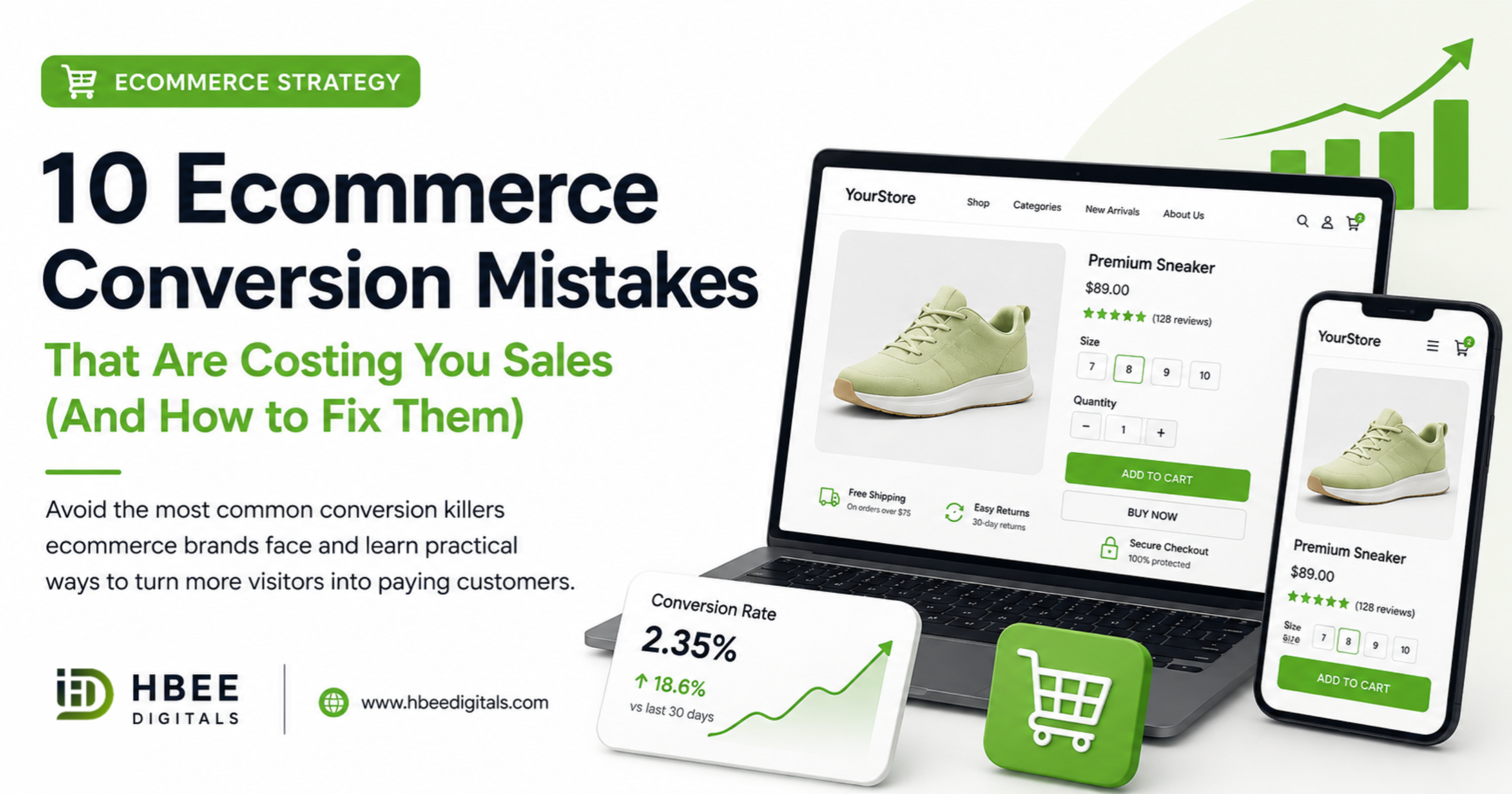
10 Ecommerce Conversion Mistakes That Are Costing You Sales And How to Fix Them
Most ecommerce stores do not only lose sales because of low traffic. They lose sales because visitors do not trust the store, understand the offer, or feel confident enough to complete the purchase. This guide explains 10 common conversion mistakes and how to fix them.
CONTENTS
Introduction
Getting traffic to an ecommerce store is important, but traffic alone does not create sales. A store can attract visitors from ads, SEO, social media, referrals, or email campaigns and still struggle to convert if the buying experience is weak.
Many ecommerce brands assume they have a traffic problem when the real issue is conversion. Visitors are arriving, browsing products, hesitating, and leaving without buying. That usually happens because something in the customer journey is creating doubt, confusion, friction, or lack of trust.
According to Shopify’s ecommerce conversion guidance, conversion rate is one of the most important performance metrics for online stores because it shows how effectively a website turns visitors into customers. You can review Shopify’s conversion rate guide here: Shopify ecommerce conversion rate guide.
At Hbee Digitals, we often find that the biggest opportunities are not always in running more ads. They are usually found in improving product pages, trust signals, mobile experience, checkout flow, content clarity, and the full path from visitor to buyer.
What Ecommerce Conversion Really Means
Ecommerce conversion is the process of turning a website visitor into a customer. A conversion can mean different actions depending on the store, but for most ecommerce brands, the main goal is a completed purchase.
Conversion rate is usually calculated by dividing the number of purchases by the number of visitors, then multiplying by 100. For example, if 1,000 people visit a store and 20 people buy, the conversion rate is 2%.
Benchmarks vary by industry, device, product type, price point, and traffic source. Littledata’s Shopify benchmark data shows that many Shopify stores sit around low single-digit conversion rates, while stronger stores perform higher depending on market and customer journey quality. You can review their benchmark data here: Littledata ecommerce conversion benchmark.
The goal is not to chase a random benchmark blindly. The real goal is to improve the quality of your store experience so every visitor has a better chance of becoming a customer.
1. Weak First Impression
Your homepage or landing page has only a few seconds to communicate what your store offers and why customers should care. If the first impression is unclear, visitors may leave before exploring your products.
A weak first impression usually looks like this:
- The homepage does not clearly explain what the brand sells.
- The hero section is too generic.
- The main call-to-action is hidden or weak.
- The design feels unprofessional or inconsistent.
- The customer cannot quickly understand the value of the products.
To fix this, your homepage should clearly answer three questions:
- What do you sell?
- Who is it for?
- Why should someone buy from you instead of another store?
A strong first impression does not need to be complicated. It needs to be clear, trustworthy, and focused on the customer.
2. Poor Product Page Structure
Product pages are where buying decisions happen. If your product page is weak, even interested visitors may hesitate.
Common product page mistakes include:
- Short descriptions that do not explain the product properly.
- No clear benefits.
- No size, material, usage, or care information.
- Weak product images.
- No reviews or proof.
- Confusing add-to-cart area.
A strong product page should include clear product images, benefit-led descriptions, specifications, delivery information, return details, reviews, trust signals, and a visible call-to-action.
Google also recommends using structured product information where relevant so search engines can better understand product details such as price, availability, ratings, and product information. You can review Google’s product structured data guidance here: Google Product structured data documentation.
3. Lack of Trust Signals
Trust is one of the biggest conversion factors in ecommerce. Customers want to feel safe before entering payment details or placing an order.
If your store lacks trust signals, customers may wonder:
- Is this business real?
- Will my order arrive?
- Can I contact someone if there is a problem?
- What happens if I need a refund?
- Have other people bought from this store?
To build trust, your store should include:
- Clear contact information.
- About page.
- Shipping policy.
- Return and refund policy.
- Customer reviews.
- Secure checkout messaging.
- Professional branding.
- Social proof where available.
Trust should not only appear at checkout. It should be visible throughout the customer journey.
4. Poor Mobile Experience
Many ecommerce customers browse and buy from mobile devices. If your store is difficult to use on mobile, conversions can drop even if the desktop version looks good.
Mobile conversion issues often include:
- Text that is too small.
- Buttons that are hard to tap.
- Images that crop badly.
- Slow-loading pages.
- Popups blocking the screen.
- Navigation that feels confusing.
- Checkout steps that take too long.
To fix this, test your store like a customer. Open your website on your phone, browse products, add an item to cart, and go through the checkout journey. Any friction you notice may also be affecting real customers.
5. Weak Product Descriptions
Many ecommerce stores describe products in a way that feels too basic. They list features but do not explain the value.
For example, instead of only saying:
Premium sneaker with soft material.
A stronger description would explain:
- What makes the material comfortable.
- When the customer should wear it.
- What problem it solves.
- How it compares to alternatives.
- Why it is worth the price.
Good product descriptions help customers imagine the product in their life. They reduce uncertainty and make the buying decision easier.
6. Confusing Navigation
If customers cannot find what they are looking for quickly, they may leave. Navigation should make shopping easier, not harder.
Common navigation mistakes include:
- Too many menu items.
- No clear product categories.
- Generic “All Products” collections only.
- No best sellers or new arrivals section.
- No search function.
Better navigation helps customers discover products faster. Useful collection examples include Best Sellers, New Arrivals, Gift Ideas, Under $50, For Beginners, Most Popular, and Product Type collections.
Strong collection pages can also support SEO because search engines can understand product groupings better when pages are properly structured and internally linked.
7. No Clear Call-To-Action
A visitor should always know what to do next. If your call-to-action is weak, hidden, or inconsistent, customers may browse without taking action.
Strong ecommerce calls-to-action include:
- Add to Cart
- Buy Now
- Shop Best Sellers
- Explore Collection
- Get Started
The call-to-action should be visible, easy to tap on mobile, and placed where the customer naturally makes a decision.
8. Checkout Friction
Checkout is the final step, but it is also where many stores lose customers. If checkout feels confusing, slow, or untrustworthy, customers may abandon the purchase.
Checkout friction can include:
- Unexpected shipping costs.
- Too many form fields.
- No guest checkout option.
- Limited payment options.
- Unclear delivery timelines.
- No reassurance near payment.
To improve checkout, make the process simple and predictable. Customers should understand the total cost, delivery options, payment security, and next steps before completing the purchase.
9. No Email Capture or Follow-Up
Most visitors will not buy on their first visit. If your store has no email capture or follow-up system, you may be losing future customers.
Email systems that support conversion include:
- Welcome series.
- Abandoned cart emails.
- Browse abandonment emails.
- Post-purchase emails.
- Review request emails.
- Repeat purchase offers.
Email capture allows your store to continue the conversation after someone leaves the website. Without it, a large part of your traffic may disappear without any follow-up.
10. Scaling Traffic Before Fixing the Store
One of the most expensive mistakes ecommerce brands make is increasing traffic before improving the buying journey.
If your store has weak trust signals, poor product pages, confusing navigation, slow mobile experience, and no follow-up system, more traffic may only create more missed opportunities.
Before scaling ads or campaigns, review the full customer journey:
- Homepage clarity
- Product page quality
- Trust signals
- Mobile experience
- Navigation
- Checkout
- Email capture
- Retention flows
Growth becomes easier when your store is ready to convert the attention it receives.
How to Fix Ecommerce Conversion Problems
If your store is getting traffic but not enough sales, start with a structured review. Do not only ask, “How do we get more visitors?” Ask, “What happens when visitors arrive?”
A practical conversion improvement plan should include:
- Improve homepage clarity.
- Rewrite product descriptions around benefits.
- Add reviews and trust signals.
- Improve mobile layout.
- Simplify navigation.
- Clarify shipping and return policies.
- Improve checkout confidence.
- Add email capture and follow-up flows.
- Use structured data where relevant.
- Review analytics to identify drop-off points.
Google’s ecommerce documentation explains that structured data can help search engines understand ecommerce pages more accurately. You can review Google’s ecommerce structured data guide here: Google ecommerce structured data guide.
Where Hbee Digitals Comes In
At Hbee Digitals, we help ecommerce brands identify the gaps that may be limiting growth. Our work focuses on improving trust, product presentation, customer journey, website structure, and conversion flow.
Instead of only making a website look better, we focus on how the website performs as a digital growth system. That means reviewing what customers see, how they move through the site, where they may hesitate, and what can be improved to turn more visitors into customers.
You can explore our digital growth services, view our recent work, or contact us through the contact page.
Frequently Asked Questions
What is an ecommerce conversion mistake?
An ecommerce conversion mistake is any issue on your website that makes it harder for visitors to become customers. This can include poor product pages, weak trust signals, confusing navigation, slow mobile experience, or checkout friction.
Why is my ecommerce store getting traffic but no sales?
Your store may be getting traffic but no sales because visitors do not trust the site, do not understand the product value, experience friction on mobile, or do not feel confident enough to complete checkout.
What is a good ecommerce conversion rate?
A good ecommerce conversion rate depends on your product type, price, industry, traffic source, and device mix. Many ecommerce stores operate in the low single digits, while stronger stores perform higher when their customer journey and trust signals are well optimized.
Should I focus on traffic or conversion first?
If your store already gets visitors but few sales, focus on conversion first. Improving trust, product pages, checkout, and email follow-up makes every future visitor more valuable.
Do trust badges increase sales?
Trust badges can help when they support a genuinely trustworthy experience. They work best when combined with clear policies, real reviews, secure checkout messaging, and visible contact information.
How can I improve my product pages?
Improve product pages by using clear images, benefit-driven descriptions, product details, reviews, shipping information, return information, FAQs, and a visible call-to-action.
Why do customers abandon carts?
Customers abandon carts for many reasons, including unexpected costs, unclear delivery timelines, limited payment options, complicated checkout steps, or lack of trust at the final stage.
How long does conversion optimization take?
Some improvements can be made quickly, such as fixing copy, trust signals, navigation, and product page structure. Larger improvements involving redesign, analytics, testing, and email flows may take longer depending on the store.
Final Thoughts
Most ecommerce stores do not only need more traffic. They need a better system for converting the traffic they already receive.
If customers are visiting your store but not buying, the issue may be trust, clarity, product presentation, mobile experience, checkout friction, or lack of follow-up.
Fixing these areas makes every future visitor more valuable. That is how ecommerce growth becomes more sustainable.
Get ecommerce growth insights in your inbox
Practical ideas on conversion, customer trust, Shopify growth, website performance, and digital systems from Hbee Digitals.
Comments
Comments are temporarily closed
We're improving how comments work. Existing comments stay visible. Have a question about your store? Contact us.