
A customer can want your product and still abandon the purchase. Not because of the price, or the photos, or the brand, but because they don't understand what happens after they click Buy.
How much will shipping really cost? When will it arrive? Will it get here before the occasion they're buying for? What if it's the wrong size? What if the courier charges them something extra at the door? A shopper who can't answer these questions doesn't always ask. Often they just leave, and you never find out why.
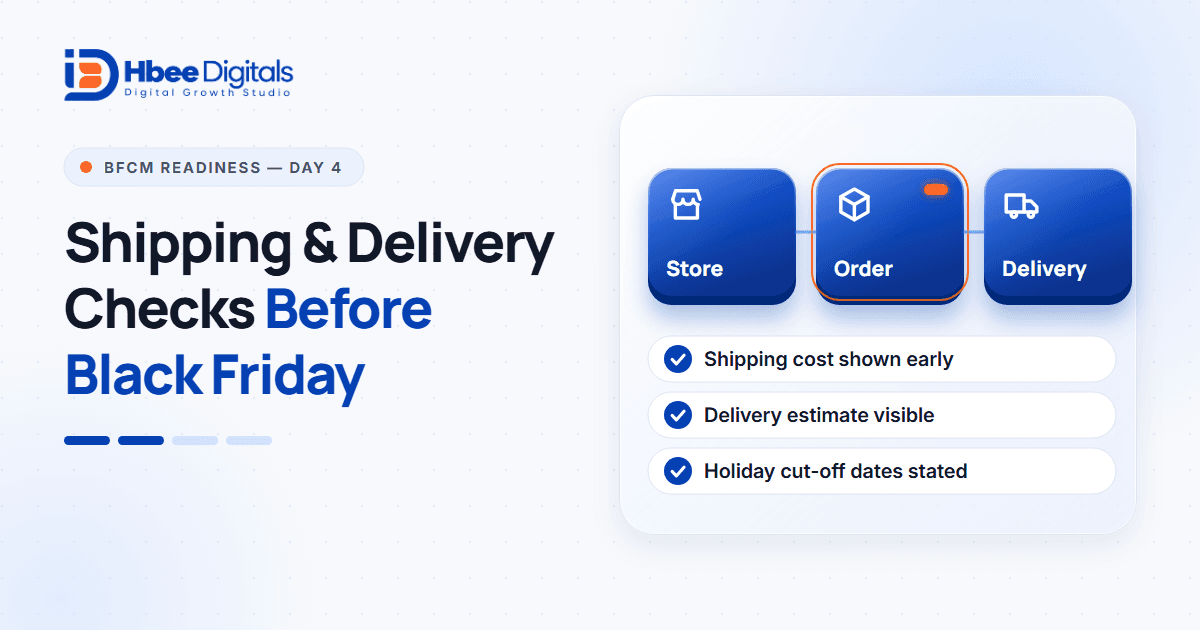
Black Friday and Cyber Monday make this more expensive. More visitors means these unanswered questions are repeated across far more sessions, and many of those shoppers are buying gifts with a date attached. Peak periods also strain fulfillment and carriers, so the delivery times that were realistic in October may not be realistic in the last week of November. This article walks through the shipping, delivery and returns checks worth making before traffic peaks. It isn't legal advice, and it doesn't ask you to promise anything you can't deliver. It asks you to look at your store the way a first-time buyer does.
Check 1: Is shipping cost visible early enough?
The most common shipping problem is not that shipping costs too much. It's that the cost appears too late. A shopper who adds a product expecting one total and sees a different one at the final step can feel misled, even if your prices are fair.
Test this yourself. Open a product page on your phone and ask: can a stranger tell what shipping will cost, or how it's worked out, without starting checkout? If your rates depend on location or weight, you can't always show one number, but you can say how it works: "Shipping is calculated at checkout based on your location. Free over $75." That one line removes a guess.
Free-shipping thresholds
If you offer free shipping above a certain order value, make the rule easy to see and easy to follow:
- State the threshold in plain words on product pages and in the cart.
- Show how far the shopper is from it ("You're $12 away from free shipping") if your theme or apps support that.
- Make sure the threshold in the banner is the same as the threshold at checkout. A promotion that says one number while checkout applies another is a quick way to lose trust.
- Check whether discount codes change the order value and affect whether free shipping still applies.
Check 2: Can customers estimate delivery before they commit?
"When will it arrive?" is a different question from "how long does shipping take?" because a delivery date has two parts, and shoppers often only see one of them.
- Processing time is how long you take to prepare and hand the order to the carrier. Shopify calls this fulfillment time: the time between when an order is placed and when you give the shipment to a carrier.
- Transit time is how long the carrier takes after that.
If your page says "ships in 3-5 days," a customer may read that as "arrives in 3-5 days." If you take two days to pack the order and the carrier takes five, they're disappointed before the parcel arrives. Say both, or show them combined as a range.
Shopify can show estimated delivery dates once you set your fulfillment time and add transit times to your shipping rates. According to Shopify's documentation, these dates can appear at checkout, in accelerated checkouts such as Shop Pay, in order confirmation emails, and on the thank-you and order details pages. Manual delivery dates, built from the fulfillment and transit times you enter, are available on all plans. Automated dates, which are predicted from your shipping history, need a Basic plan or higher and some fulfilled domestic orders. If you haven't set this up, it's worth checking what your checkout shows today.
If your product pages say one thing and checkout shows another, the mismatch costs you trust.
Check 3: Are BFCM and holiday cut-off dates stated?
Many BFCM purchases are gifts, which means the shopper is working backwards from a date. They want to know: if I order today, will it arrive in time? If your store doesn't say, they have to guess, or leave to find a store that does.
A useful cut-off statement is specific and honest about what you can and can't control. For example:
- "Order by December 12 for standard delivery in time for the holidays."
- "Orders placed after December 12 will still ship, but we can't guarantee holiday arrival."
Notice what's missing: a promise that every order will arrive on a given day. Carriers publish their own holiday shipping deadlines each year, and those dates vary by service and by route. Check your carrier's current published schedule rather than relying on last year's, and add a buffer so your public cut-off sits comfortably ahead of theirs.
Put the cut-off on product pages, in the cart and in an announcement bar during the sale, and check that the same date appears in your shipping policy and any ads or emails.
Check 4: Are local and international expectations separated?
Domestic and international shipping are very different experiences for a shopper, and one block of text rarely serves both. If you ship abroad, make sure customers in other countries can find information written for them: expected delivery windows, which countries you ship to, and whether anything extra may be charged.
Duties and import taxes
For international orders, duties and import taxes can be the biggest source of surprises. Shopify gives store owners two ways to handle them at checkout in a market: show duties as a line item added to the customer's total, or absorb them by choosing "duties included in price." Shopify's documentation notes that when duties are collected at checkout, estimated duties are displayed during checkout and paid upfront, which reduces surprises when the package arrives. It also notes that the line-item option might affect your checkout rate, so it's a trade-off to think about, not a free win.
Two things are worth knowing. First, Shopify describes the amounts as estimates based on the information available when the order is placed. If product information such as the country of origin or the Harmonized System (HS) code is missing or wrong, the customer may be charged additional duties on delivery. Second, some countries have thresholds below which no duties are charged, so small orders can behave differently from large ones.
You don't need to become a customs expert before Black Friday. Decide what your store does, say it clearly, and check that the product data behind it is accurate. If you're not sure how your international setup behaves, test an order to another country and see what the customer sees. For anything that depends on local law or tax rules, check with a qualified professional.
Check 5: Are returns and exchanges easy to find?
Shoppers read returns information before they buy, because it tells them how risky the purchase is. During BFCM sale items often come with different rules, and a customer who can't tell whether a discounted item is returnable will often hesitate.
Ask yourself:
- Can a shopper find your return policy from a product page in one tap, on a phone?
- Does it say clearly how long they have, what condition items must be in, and who pays for return shipping?
- If sale items have different rules, is that stated plainly where the offer is shown, not only in the policy?
- Is it clear what an exchange involves, and what a refund looks like and roughly when to expect it?
Shopify's documentation says that once you add store policies, they're linked in the footer of your checkout pages, that a shipping policy link is listed on product pages and the cart, and that a return policy link appears on the order review page. It also recommends linking your policies from your store menus or footer, because customers may need to read them before they check out. Themes behave differently, so don't assume. Look at your own store on a phone and see whether the links are really there.
Shopify's automated policy templates are informational and aren't legal advice. You're responsible for making sure your published policies are accurate and that you follow them. If you change your returns rules for BFCM, update the policy as well as the banner.
Check 6: Is order tracking explained?
Once someone has paid, the next question is "where is it?" Customers who can't answer that tend to contact support, and during BFCM support is busy. A little clarity up front saves a lot of messages later.
- Say what customers will receive after ordering: a confirmation, then a shipping notification with tracking.
- Explain roughly when tracking becomes active. Tracking often doesn't update until the carrier scans the parcel, which can be a day or more after dispatch, and customers who see "no information" may worry.
- Make it easy to find the tracking link again, and tell customers where to look if they lose the email.
- Tell them how to contact you, and what you'll need, such as an order number.
Put this on your shipping page and in the confirmation email. It's short reassurance that doesn't promise anything you can't control.
Check 7: Does checkout introduce shipping surprises?
The most useful test in this whole article is to place a test order, stopping before payment, and compare what you were told at each step. Write down:
- The shipping cost and delivery message on the product page.
- What the cart says.
- What checkout shows, including taxes and any extra fees.
- What your shipping policy says.
- What your promotional banner or ad says.
Look for any place where those disagree. A product page that says "free shipping" while checkout charges for a particular method, a banner promising next-day dispatch while the policy says three business days, a discount code that quietly removes the free-shipping threshold: these are the small inconsistencies that make shoppers stop trusting the page. Promotional shipping claims should match what actually happens at checkout, every time.
If you'd like the broader version of this exercise, our guide to identifying friction in a Shopify store covers how to look for these gaps across the whole buying journey.
Check 8: Can mobile shoppers find all of this?
Information that sits in a long footer, a small tab or a pop-up may be present on desktop and practically invisible on a phone.
Repeat the checks above on your own phone. Can you find the shipping cost, the delivery estimate, the cut-off date and the returns link, and does anything cover them? Our article on mobile store checks to make before Black Friday goes through how to test the whole experience, and the product page questions your store should answer includes "when will it arrive and what happens if something goes wrong?" as one of seven.
What if you can't guarantee delivery by a specific date?
Sometimes you can't, and that's normal. Carriers get busy and weather happens. Customers forgive a clear limit much more readily than a broken promise, and a cautious estimate is easier to beat than an ambitious one.
- Use ranges instead of single dates where you're not certain.
- Separate what you control (when you dispatch) from what you don't (when the carrier delivers).
- Be explicit about the last date after which you can't expect holiday arrival.
- Don't present a faster shipping option as a guarantee unless it is one.
- Decide in advance what you'll do if there are delays, and say how customers can reach you.
Quick shipping and delivery readiness check
Use this as a short review of your store. You should be able to answer yes to each question, as a first-time shopper on a phone, without using anything you already know from running the store.
- Can a customer understand the shipping cost, or how it's calculated, before checkout?
- Can they understand roughly when the order will arrive?
- Are processing time and shipping time shown as separate things, or clearly combined into a range?
- Are BFCM and holiday cut-off dates visible, and consistent everywhere they appear?
- Are returns and exchanges easy to find from a product page?
- Do mobile shoppers see the same shipping and returns information as desktop shoppers?
- Does checkout match what product pages, banners and policies promised?
- Can customers find out how to track their order after purchase?
- If you ship internationally, is it clear whether duties and import taxes may apply?
- Are your delivery promises realistic for peak season, with a sensible buffer?
Every "no" is something to fix first. An "I'm not sure" usually means a customer wouldn't be sure either.
Where to go next
Shipping and delivery are one part of BFCM readiness. If you'd like to check the rest of your store, the Free 15-Point BFCM Readiness Checklist covers mobile experience, product pages, shipping, checkout and tracking, and you can work through it at your own pace. For a wider view of the season, see our note on November 2026 e-commerce readiness.
If you've done the checks and aren't sure which problems matter most, a Free Growth Review is the next step: within 24 hours, we'll review your store and send you the top 3 things we'd fix first. Free. No account needed. No obligation.
Frequently asked questions
What shipping information should an online store show before Black Friday?
At a minimum: the shipping cost or how it's calculated, any free-shipping threshold, expected processing and delivery times, holiday or BFCM order cut-off dates, how returns and exchanges work, and how customers can track an order. If you ship internationally, add where you ship and whether duties or import taxes may apply.
Should shipping costs be shown before checkout?
Yes, where you can. Shoppers dislike discovering costs late. If rates depend on location or weight, you may not be able to show one number, but you can explain how the cost is worked out, show a free-shipping threshold, or offer a shipping estimate in the cart so the final total isn't a surprise.
How should Shopify stores communicate holiday delivery cut-off dates?
State them clearly and in more than one place: on product pages, in the cart, in a banner and in your shipping policy. Word them carefully, for example "order by this date for expected delivery before the holidays," and avoid promising a specific arrival day. Check your carrier's published holiday schedule and keep a buffer.
What is the difference between processing time and delivery time?
Processing time is how long it takes you to prepare and hand over an order to the carrier. Shopify calls this fulfillment time. Delivery time, or transit time, is how long the carrier then takes. The customer's real wait is both added together, so showing only one of them can set the wrong expectation.
Should an ecommerce store guarantee Christmas delivery?
Only if you're confident you can honor it. For most stores it's safer to state a last recommended order date and explain that after it, holiday arrival can't be guaranteed. A clear limit builds more trust than a promise you might break.
Where should returns information appear during BFCM?
Where shoppers make the decision: near the Add to Cart area on product pages, in the cart, and in your footer or menu. If sale items have different rules, say so next to the offer, not only in the policy. Shopify's documentation recommends linking your policies in your menus or footer as well.
What should I check if customers are abandoning checkout because of shipping?
Place a test order and compare each step. Look for shipping costs that appear late, delivery times that differ from the product page, thresholds that don't match the banner, and unexpected taxes or duties. Then ask someone who has never used your store to try it on a phone and tell you where they hesitate.
Sources and further reading
- Shopify Help Center, Getting started with fulfillment time and delivery dates. Supports the definition of fulfillment time, the manual and automated delivery date options and plan requirements, and where delivery dates appear (checkout, accelerated checkouts such as Shop Pay, order confirmation emails, and the thank-you and order details pages).
- Shopify Help Center, Collecting international duties and import taxes at checkout. Supports the statements that duties and import taxes charged at checkout are estimates, and that missing or incorrect product information can lead to additional duties charged on delivery.
- Shopify Help Center, Setting up duties and taxes for markets. Supports the "show as line item" and "duties included in price" options, the note that showing estimated duties at checkout reduces surprises on delivery, and the note about de minimis thresholds.
- Shopify Help Center, Adding store policies. Supports where saved policies are linked (checkout footer, order review page, and product pages and cart for the shipping policy), the recommendation to link policies in menus or the footer, and the note that automated policy templates are informational and aren't legal advice.
- Carrier holiday shipping deadlines change every year and vary by service and route. Check your own carrier's current published schedule rather than relying on a summary.